December 22, 2025
Nursing Amid Conflict in Sudan: The Story of Azza in Al-Naw Hospital
WORDA


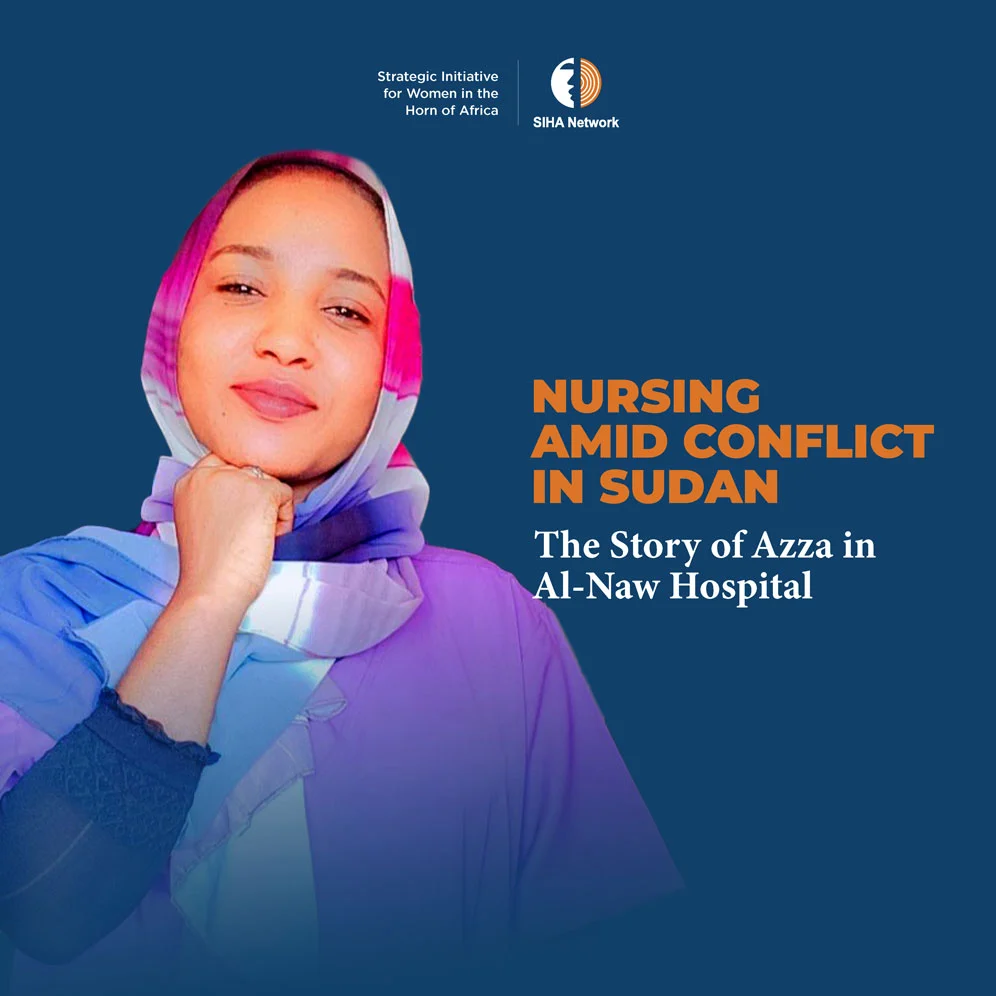
Azza Abdullah is a 29-year old nurse from Omdurman. She worked at Al-Naw hospital for a few months during the early days of the war, in Khartoum State.
When the war began on April 15, 2023, Azza Abdullah had previously been working at a hospital in Omdurman, however, within the first week of fighting, Al-Naw Hospital was overwhelmed with those in critical condition and issued an urgent notice calling for doctors, nurses and other medical professionals to volunteer their services to the hospital. Azza did not hesitate and took immediate steps to support.
Within a few months, Al-Naw became the only major functioning hospital in all of Khartoum State. As reported by the World Health Organization (WHO), in the first ten (10) months of the war, 70% of medical facilities were inoperable or beyond the reach of communities. Health care professionals were also targeted with kidnaping, death and intimidation as millions fled Khartoum, the epicenter of the war, searching for safety.
Largely operated by volunteers from the area and receiving some support through crowd-sourcing and international organizations, Al-Naw Hospital became a beacon for hope amid conflict and destruction. This was made possible because of people like Azza who worked hard amid turmoil, daily bombardment and even during a direct artillery attack fired at the Hospital.
“My first time entering Al-Naw was during the war. It was very difficult. Many times, it was impossible to go home so I would just stay in the hospital. There was also ongoing fighting. In the first month, I also treated [Rapid Support Force] RSF soldiers. We have an oath so we treat everyone,” Azza recalled.
After the initial shock of the hostilities, people in the area quickly ensembled as a united front and began to organize themselves in service to the community. Volunteers became critically important in the hospital. Azza believes that this collective and very communal effort held the hospital together during the most difficult times.
“They [the volunteers] provided transport for us to make sure we got home at times of insecurity and lack of fuel, they did everything from cleaning the hospital to transporting oxygen for patients.” Azza recollected.
She also added, “Al-Naw was driven by the community. In the beginning, there was no food available. The youth from the surrounding neighborhoods would bring food …to us. They would even make food for us in the houses around the hospital. This food was for the nurses and even the patients.”
Working at Al-Naw Hospital during this exceptionally dark time was not easy, but Azza continued to show up to meet this challenge daily.
“The biggest challenge we faced in the early days was the lack of oxygen tanks. The patients were in desperate need and we would literally wait for people to die because it was unavailable. In the first days, people died due to shock and not just gunshots … fatality was very high. When they hear the fighting, they get scared. I remember one woman, [who] heard the fighting …she fell in the bathroom, broke her leg and entered into a diabetic coma. She died when she couldn’t get oxygen. The cases that needed surgical interventions were better than those needing oxygen,” Azza detailed.
Azza shared her shock, remembering when a member of the Hospital’s operational staff came to open the accounting office during those early days. “I remember telling her, look you can’t charge people now, we are here as volunteers so we are not making money, not only that but we [need to] raise funds to buy medicine for those with chronic diseases.”
Working under pressure is something that Azza is used to, but working under constant bombardment and siege is exceptionally difficult to endure. Although the war never officially reached Karari where Al-Naw Hospital is located, the drone strikes were endless and the Hospital was overwhelmed with patients from the frontline.
According to Azza, “We worked when there was fighting and the sounds were very loud. I also remember the pressure we faced because our hospital also accepted some military patients even though it’s a civilian hospital. The military patients wanted priority and we would be intimidated. We were also accused of treating RSF soldiers. So it was a lot of tension. Our ability to move between the hospital and our homes was also challenged. We had to use dark streets and many times, we would be stopped at checkpoints – soldiers looked at us with suspicion.”
Azza kept going because she believed that the work she did was needed. She also received immeasurable support from her family who would make sure she was safe. Sometimes they would even send food with her to the Hospital.
“The majority of the volunteers in the hospital were [women], they did a lot. I felt that the female volunteers were more than the male volunteers. The staff was also majority female. The female volunteers, mostly from the 8th neighborhood where the hospital lies, engaged in significant free labour to make the hospital a better environment,” Azza recalled in admiration.
Together, Azza and the rest of the volunteers bravely took on the most heart retching cases.
“One of the volunteers at the hospital … literally slept at the hospital and [he] never went home [which allowed him] to continue taking care of people. A bomb fell on his family’s home and he brought [his family] to the hospital. They were all injured, it was very sad. [In] another case, I was working and then saw a friend of mine, she was in her wedding toub, the red Jirtik toub and I asked her why she was here … she said that her father fell sick and he had a heart condition. We tried our best because the entire hospital was occupied by the newly-weds. In the end, he [her father] passed away. We were all touched, even the patients,” recalled Abdullah.
Working in Khartoum State during the war and later in Sinja, Sennar State exposed Azza to how compromised the health care system in Sudan is.
“I wish I could become a minister to make it better. We need to work on … infrastructure such as the sewage system. We need a better culture and to build awareness to ensure that we don’t have ongoing pandemics which I believe is a constant problem [causing] stress to our healthcare system and to … communities,” Azza observed.
In addition to her professional work, Azza also opened a Takia or a community kitchen in Sinja. When it ran, the Takia provided food, sanitary pads, dignity kits and a safe space for women and girls to meet and organize.
“We had a lot of displaced in Sinja, but now many of them have returned and for this reason, my Takia came to an end. In its place, I organize monthly food baskets for families still in the area,” Azza explained.
Ultimately, Azza’s story illustrates the power of volunteerism and the critical impact that is created when individuals open their hands and hearts towards serving the community at pivotal times of need.
Note: SIHA Network gave Azza Abdullah two (2) small grants to support her Takia or community kitchen.
December 22, 2025
Nursing Amid Conflict in Sudan: The Story of Azza in Al-Naw Hospital
December 22, 2025
Nursing Amid Conflict in Sudan: The Story of Azza in Al-Naw Hospital
December 22, 2025
Nursing Amid Conflict in Sudan: The Story of Azza in Al-Naw Hospital